
Sodium nitrite, listed on labels as E250, is one of the most widely used preservatives and curing agents in the food industry, especially in cured and processed meats. If you’ve ever spotted that code on your ham, bacon, or sausages and wondered what it means, this article explains it clearly and without scaremongering: what this food additive actually is, what it’s used for, which foods contain it, what the scientific evidence says about its safety, and how to manage your intake. The goal isn’t to demonize an ingredient — it’s to help you read the label better and make informed choices for yourself.

What Is Sodium Nitrite?
Sodium nitrite is a salt (chemical formula NaNO₂) used as a food additive with a preservative function, and as a curing agent. It belongs to the group known as curing salts or nitrite curing salts, the modern heirs of a very old preservation technique: salting. What was once done crudely with common salt and saltpetre is now carefully controlled with regulated doses of nitrites and nitrates to keep food safe.
The E250 on the Label: How to Spot It
In the ingredient list, this additive can appear in several ways: E250, sodium nitrite, or wrapped into a mention like “curing salt.” They all refer to the same compound. Recognising it at a glance is the first step toward making conscious decisions when you fill your shopping basket.
Sodium Nitrite vs. Nitrates and Other Nitrites
These additives are easy to mix up, so it’s worth telling them apart clearly:
- E249 – potassium nitrite
- E250 – sodium nitrite (the focus of this article)
- E251 – sodium nitrate
- E252 – potassium nitrate
The practical difference is simple: nitrites (E249-E250) act directly and immediately to preserve the meat, while nitrates (E251-E252) act as a kind of “reserve” that slowly converts into nitrite during curing. That’s why both groups are often mentioned together in legislation and on the labels of traditional cured products.
Is It a Natural or Synthetic Additive?
The nitrite added to food is produced industrially, but it’s important to know that nitrates and nitrites are also naturally present in many vegetables, such as spinach, beetroot, lettuce, and celery. In fact, a large share of the nitrates we consume comes from vegetables. So this isn’t some “alien, artificial” substance: the real debate isn’t about its origin, but about the total amount, the source, and the context in which it’s eaten.
What Is Sodium Nitrite Used For?
Here’s the point many articles skip: E250 isn’t added arbitrarily. It performs very specific technological and safety functions that explain why its use remains authorised.
Preservative: Slowing Bacterial Growth
As a preservative, sodium nitrite inhibits the growth of microorganisms in processed meats. This extends the product’s shelf life and reduces the risk of foodborne illness — an especially important point in foods that aren’t cooked before eating, such as many deli meats and cold cuts.
Preventing Botulism
Its most critical role is to prevent the growth of Clostridium botulinum, the bacterium responsible for botulism, a rare but potentially fatal poisoning. This is the compelling reason health authorities keep nitrite on the list of approved additives: removing it entirely, with no equivalent alternative, would increase a real and serious microbiological risk.
The Pink Colour and Characteristic Cured Flavour
Nitrite is also responsible for the stable pink colour of hams, sausages, and cured meats, and it contributes to the flavour and aroma typical of curing. Without it, many meat products would take on an unappetising greyish tone and lose much of their characteristic sensory profile.
Which Foods Contain E250?
Sodium nitrite is found mainly in processed, cured, and charcuterie-style meats. These are the groups where you’re most likely to see it on the label:
Cured Meats and Charcuterie
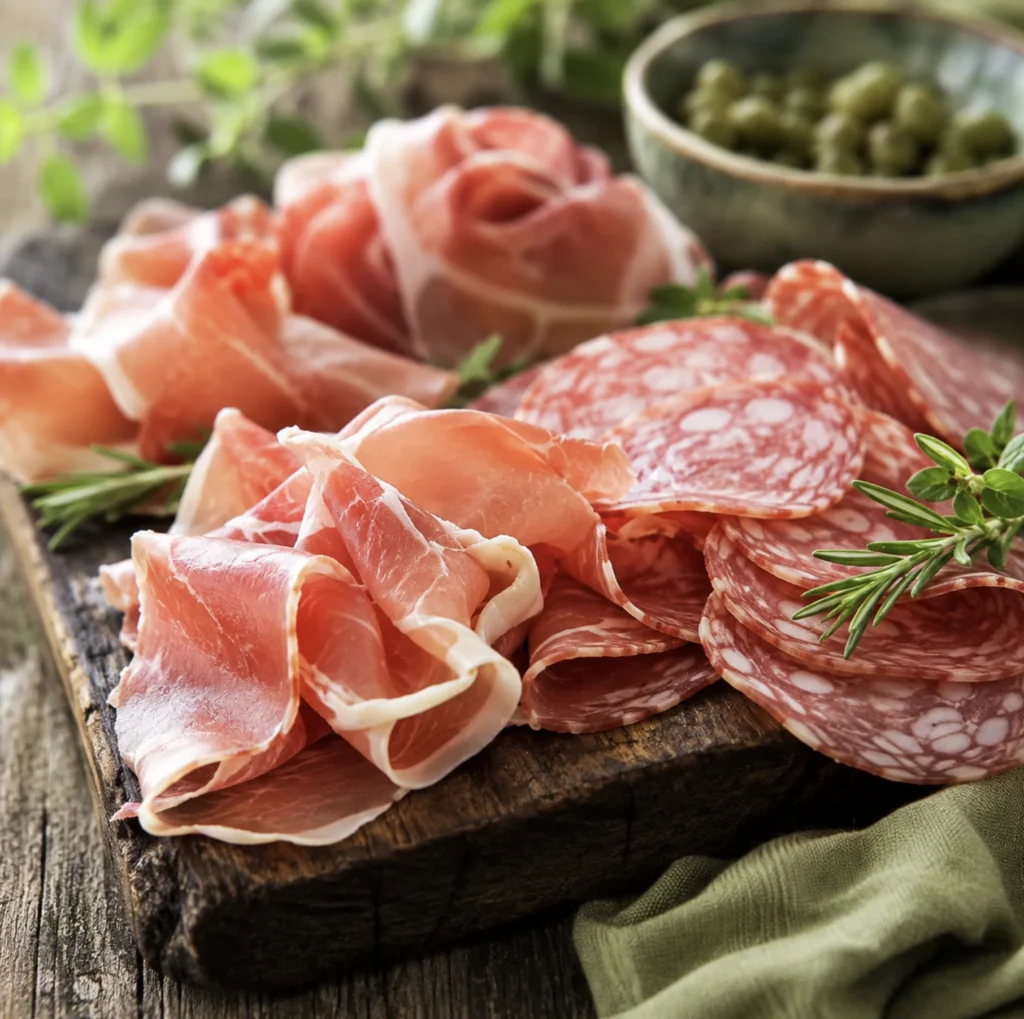
Cured ham, chorizo, salami, saucisson, and other traditional cured products often include it as part of the salting and curing process.
Processed Meats
Bacon, sausages, cooked ham, processed turkey, cold cuts, mortadella, pâté, and hot dogs are some of the products where E250 appears very frequently.
Other Products Where It May Appear
Beyond meat, some cured and processed cheeses, as well as certain canned or marinated fish, may contain added nitrites or nitrates as preservatives. So it’s worth not assuming a product is “clean” simply because it isn’t a cured meat.
How to Spot It Quickly by Reading the Label
You don’t need to memorise codes. Just check the ingredient list and look for “E250,” “sodium nitrite,” or “curing salt.” And if you want to do it in seconds — without effort and without squinting at the fine print — a label-scanning app can identify the additive automatically for you.
📲 With AvoidAdditives you can scan a product’s barcode or take a photo of the ingredient list, and the app instantly detects whether it contains E250 or other nitrites. You can even set up a custom alert for E250 and get notified whenever it shows up in a product you check.

Is Sodium Nitrite Bad for You? What the Evidence Says
This is the question most people search for, and it deserves a measured, nuanced, evidence-based answer — far from both alarmism and total complacency.
Nitrosamines: When and How They Form
The main concern isn’t so much nitrite itself, but nitrosamines — compounds that can form when nitrites react with the proteins (amines) in meat, especially when cooking at high temperatures. Frying bacon until it’s heavily charred is a classic example of a situation that favours their formation. Several nitrosamines are considered potentially carcinogenic, which is why both regulatory and culinary strategies aim to minimise their appearance. At home, it helps to avoid overly aggressive cooking and not to burn cured meats; the industry, for its part, often adds antioxidants such as vitamin C (ascorbic acid) to limit their conversion into nitrosamines.
Processed Meat and the WHO Classification
In 2015, the International Agency for Research on Cancer (IARC), part of the WHO, classified processed meat as carcinogenic to humans (Group 1), linking it mainly to colorectal cancer. It’s important to understand the nuance: the IARC classification measures the strength of the evidence, not the size of the risk. High, sustained consumption of processed meat is associated with an increased risk, whereas occasional and moderate consumption represents a very different exposure. In other words, eating cured meat every day isn’t the same as having it now and then within a varied diet.
Acceptable Daily Intake and Dose
The European Food Safety Authority (EFSA) has established an acceptable daily intake (ADI) for nitrites — a reference value considered safe within authorised use limits. As with other additives, the key lies in the dose and total exposure over time, not the occasional presence of the compound. These values are reviewed periodically as scientific knowledge advances.
Banned or Regulated? Current Legal Status
Sodium nitrite is not banned, but it is increasingly restricted. In the European Union, Regulation (EU) 2023/2108 lowered the maximum levels of nitrites (E249-E250) and nitrates (E251-E252), with the new amounts in force since 9 October 2025: a reduction of around 20% in the maximum added amount, limits now expressed as the nitrite/nitrate ion, and — as a novelty — mandatory residual limits in the finished product. A second phase in October 2026 is also planned, affecting nitrates in certain cheeses. The stated goal is to keep nitrosamine formation as low as possible without giving up the microbiological safety the additive provides against botulism.
How to Reduce Your Exposure Without Obsessing Over It
Neither panic nor indifference: the most sensible approach is balance and good habits.
Cut Back on Ultra-Processed Foods
The most effective step isn’t chasing a single additive, but reducing the frequency of processed and ultra-processed meats in your diet, giving more room to fresh foods, legumes, vegetables, and less-processed proteins.
Watch Out for “No Added Nitrites”
Many products labelled “no added nitrites” rely on vegetable extracts (such as celery or beetroot) that are rich in natural nitrates which, during processing, also convert into nitrites. In other words, “no nitrites” doesn’t always mean “nitrite-free.” It pays to read the label carefully and not be swayed by the front-of-pack claim alone.
The Key Habit: Always Read the Label
In the end, it all comes down to one simple but powerful habit: reading the label before you buy. The better you understand a product’s composition, the easier it becomes to choose according to your lifestyle, your preferences, and your personal sensitivities.
Frequently Asked Questions About Sodium Nitrite
Are sodium nitrite and nitrate the same thing?
No. Sodium nitrite (E250) acts directly and immediately in preservation, while sodium nitrate (E251) slowly converts into nitrite during curing. They’re related, but not identical, and they don’t behave the same way.
Is E250 banned in Europe?
No, E250 is still authorised in the European Union. What has changed is that its maximum levels were reduced by Regulation (EU) 2023/2108, in force since October 2025, to minimise nitrosamine formation while maintaining protection against dangerous bacteria.
Does sodium nitrite cause cancer?
Sodium nitrite itself is not a direct carcinogen, but it can give rise to nitrosamines, some of which are potentially carcinogenic. The WHO classified processed meat as carcinogenic (Group 1), linked mainly to colorectal cancer, at high and habitual consumption levels. Moderation is key.
How is it different from potassium nitrite (E249)?
Both are nitrites with the same preservative and curing function. The difference lies in the salt’s cation: sodium in E250 and potassium in E249. In practice, they play a very similar role in the food.
Are “nitrite-free” cured meats safer?
Not necessarily. Many use plant-based nitrates that convert into nitrites all the same. On top of that, nitrite serves a genuine safety function against botulism, so its absence doesn’t automatically mean a “better” product. What matters is moderation and reading the label carefully.
How much sodium nitrite is safe?
Authorities define an acceptable daily intake (ADI) considered safe within authorised uses. As with almost everything, what matters is total exposure over time, not a single serving within a varied diet.
Conclusion: Informed Choices, Not Fear
Sodium nitrite (E250) is a good example of why additives aren’t simply “good” or “bad.” It performs an important safety function — preventing botulism and preserving meat — while also calling for moderation because of its link to nitrosamines and processed meat. The point isn’t to demonize it, but to understand it and make choices that fit your habits.
🍏 AvoidAdditives makes it easy. Scan any product, discover which additives it contains, browse our E-number database, and set up alerts for the ingredients you want to watch, like E250. Stop guessing what you eat: scan, check, learn, and choose better.